If you’ve ever rolled out a mat hoping to “loosen up” or finally touch your toes, you’ve probably wondered: Is Pilates good for flexibility? The short answer is absolutely. But the why and how behind Pilates’ flexibility benefits might surprise you. Unlike traditional stretching or even yoga, Pilates helps you build flexibility through strengthened movement. At FIT 407, we often say flexibility without control is like a car with no brakes; you might go far, but not safely or efficiently. Pilates trains your body to lengthen and move freely, while maintaining the stability and strength that keeps joints supported and muscles balanced.
Flexibility vs. Mobility
Before diving into comparisons, let’s clear up two often confused terms: flexibility and mobility.
- Flexibility is your ability to lengthen a muscle or group of muscles, think of touching your toes or doing the splits.
- Mobility, on the other hand, is your ability to move a joint through its full range of motion with control.
Traditional stretching focuses mostly on flexibility lengthening tight muscles through static holds. But Pilates goes further by pairing lengthening with strength and control. The result? You don’t just get looser; you get more functional movement that carries over into your workouts, sports, and daily life.
How Pilates Builds Flexibility Differently
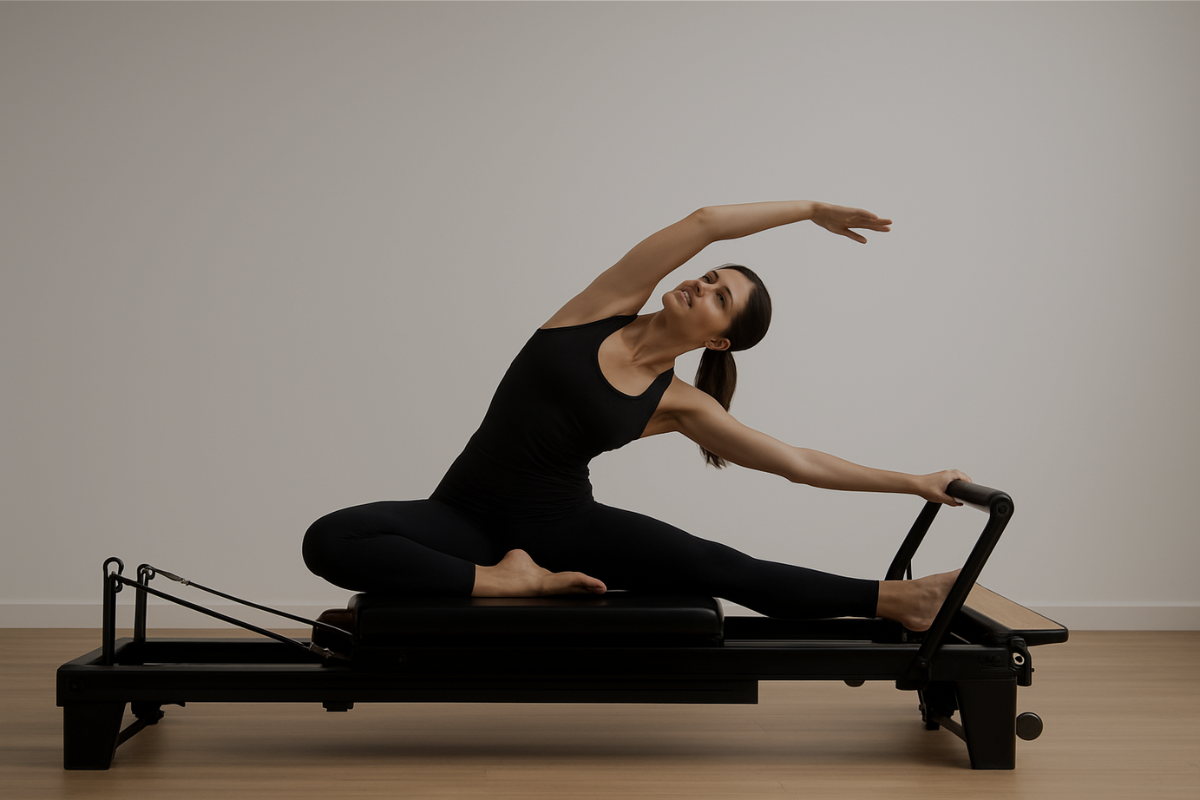
In Pilates, every stretch is an active movement. Instead of passively holding a position, you’re engaging muscles to both stabilize and lengthen your body. This approach trains your nervous system to allow greater range of motion while maintaining muscular support creating flexibility that lasts.
For example, when working on tight hamstrings, a traditional stretch might have you sit and reach forward, holding the position for 30 seconds. In Pilates, we might use a movement like the leg circles or roll up. These moves gently lengthen the hamstrings while engaging the core, hip flexors, and stabilizing muscles. Over time, your body learns not only to stretch the hamstrings but also to move fluidly through that range with control.
The same principle applies to other commonly tight areas like:
- Hips: Pilates bridges and leg lifts open the hip flexors while strengthening the glutes and core.
- Shoulders: Arm arcs and reformer movements help loosen shoulder joints while reinforcing upper back stability.
- Spine: Movements like the spine stretch forward or cat cow articulation teach segmental control, improving both posture and flexibility in the back.
It’s this blend of strength and length that makes Pilates flexibility so functional. You’re not just stretching muscles, you’re re educating your body to move more efficiently.
Pilates vs. Traditional Stretching
Both Pilates and stretching can help you move better, but they work in different ways:
| Traditional Stretching | Pilates |
| Focuses on holding muscles in a lengthened position | Focuses on moving muscles through controlled, lengthened motion |
| Primarily passive | Always active and strength based |
| Temporary increase in flexibility | Builds long term, functional mobility |
| Isolates one area at a time | Integrates the entire body in coordinated movement |
So while stretching can feel good and provide quick relief, it doesn’t necessarily train your body to use that new range of motion effectively. Pilates fills that gap by combining strength and control, so your flexibility becomes part of your natural movement pattern, not something that disappears the next day.
Pilates vs. Yoga
It’s no secret that Pilates and yoga often get compared; they both emphasize mind body connection, breathing, and flexibility. But their goals and methods are a bit different.
Yoga typically focuses on static postures held for longer durations, often paired with mindfulness or meditation. This can be fantastic for promoting relaxation, balance, and deep stretching. However, yoga’s flexibility often comes from holding positions rather than moving through them.
Pilates, by contrast, is all about dynamic control. Movements are intentionally sequenced to strengthen and lengthen at the same time. For example, the swan exercise opens the chest and stretches the front body, but it’s also strengthening the back extensors and glutes. You’re always balancing mobility with stability creating muscles that are both supple and strong.
That’s not to say one is better than the other; they simply serve different purposes. Yoga can enhance mindfulness and static flexibility, while Pilates builds the strength to move through life’s demands whether you’re reaching overhead, twisting to grab something, or improving your golf swing.
Why Active Flexibility Matters
Think of flexibility like a rubber band. A weak, overstretched band might reach far, but it doesn’t snap back or hold tension. Pilates helps you become a strong rubber band capable of stretching with control and returning to a stable base.
This kind of active flexibility:
- Reduces the risk of strains and injuries
- Improves posture and spinal alignment
- Enhances athletic performance by allowing smoother, more efficient movement
- Increases circulation and body awareness
And because Pilates emphasizes mindful breathing and precise control, it also helps calm the nervous system allowing tight muscles to release naturally.
Flexibility that Works for You
At FIT 407, we see flexibility as part of a bigger picture: helping you move better, feel looser, and perform at your best. Whether you’re a runner with tight hips, a desk worker with stiff shoulders, or someone who just wants to feel lighter in their body, Pilates offers a smarter way to unlock your mobility.
During our sessions, you’ll learn to connect breath with movement, build deep core support, and lengthen muscles through strength based exercises not just stretches. Over time, you’ll notice that bending, twisting, and reaching feel easier and more natural. Your flexibility becomes something you live in, not something you chase on the mat.
Ready to Feel the Difference?
If you’ve been stretching without seeing lasting results or if yoga feels too static, Pilates might be the missing link. At FIT 407, our instructors specialize in helping clients build flexibility that feels strong, stable, and sustainable.